
How Do Businesses Improve Visibility in AI Search Results?

Updated: Jul 26
AI Search Visibility Improves when a Business becomes easier to Understand, Trust, and Reuse
Traditional search visibility was largely built around rankings, businesses focused on improving the position of webpages inside search results, with the assumption that stronger rankings would naturally lead to more clicks, traffic, and visibility.
AI search systems work differently, they retrieve information from multiple sources, evaluate which information appears most relevant and trustworthy, then reinforce patterns over time through repeated associations and corroboration. This process plays a major role in how AI systems decide which brands to mention in generated answers.
Platforms like ChatGPT, Gemini, Perplexity, and Google AI Overviews increasingly generate answers directly inside the interface itself. Instead of simply presenting a list of links, these systems retrieve information from multiple sources, evaluate which information appears most useful and trustworthy, then assemble responses for the user.
This changes what visibility actually means.
A business no longer becomes visible simply because a page ranks well, visibility now depends on whether AI systems can confidently understand the business, associate it with relevant topics, and reuse its information inside generated answers, summaries, comparisons, and recommendations.
This is why ranking highly in traditional search does not automatically guarantee inclusion in AI-generated responses. AI systems are not just evaluating webpages individually.
They are continuously assessing:
what a business is
what topics it is associated with
whether its information appears consistent across sources
whether its content can be extracted and reused clearly
and whether the business appears trustworthy enough to recommend
Over time, stronger visibility emerges when these signals reinforce one another consistently, this creates a shift away from isolated ranking tactics and toward building clearer entity definition, stronger topic associations, reusable content structures, and more reliable authority signals across the web.
The businesses most likely to improve visibility in AI search are typically the ones that become easier for AI systems to understand, retrieve, trust, reuse and recommend confidently over time.
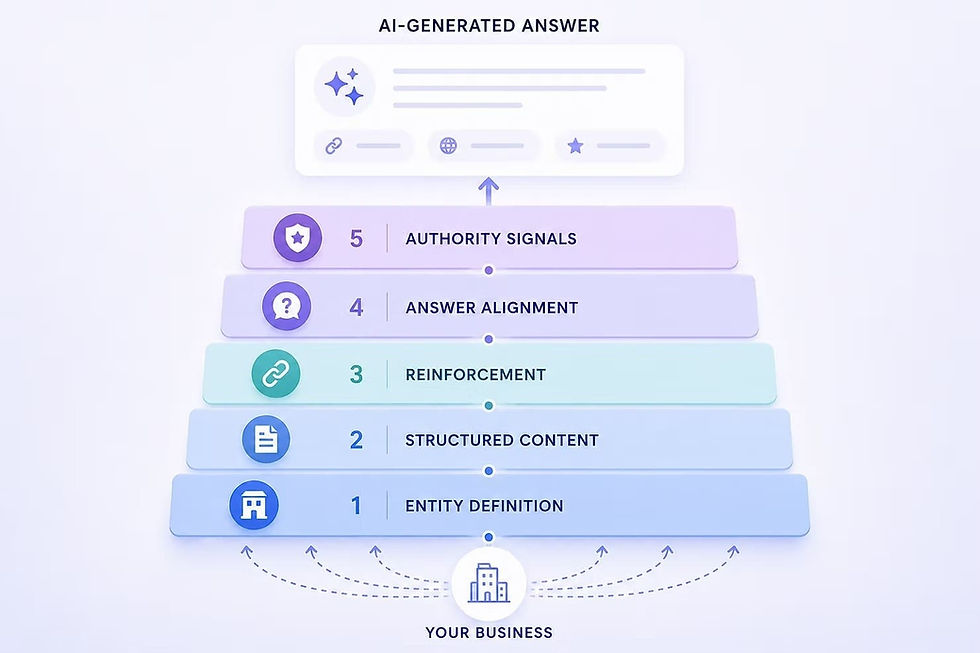
The AI Visibility Engine™ was developed around this shift. Rather than treating AI visibility as a collection of disconnected tactics, it provides a structured framework for strengthening the signals that influence how AI systems interpret, select, and recommend brands within generated answers.
Step 1: Strengthen Entity Definition So AI Systems Know What the Business Is
Define the business, category, audience, and expertise clearly
Before AI systems can confidently recommend a business, they first need to understand what the business actually is. This goes beyond simply having a website or publishing content.
AI systems attempt to build associations around entities by identifying:
what a business does
what topics it specialises in
who it helps
what category it belongs to
what types of problems it should be relevant for
The clearer these signals become, the easier it becomes for AI systems to retrieve the business during relevant searches, comparisons, and recommendation scenarios.
Many businesses unintentionally weaken these associations through vague positioning, inconsistent messaging, or overly broad content strategies. If a business describes itself differently across pages and platforms, AI systems may struggle to confidently determine how the brand should be categorised or when it should appear inside generated answers.
Clear entity definition helps reduce this ambiguity.
Businesses that consistently reinforce the same expertise areas, services, and topic associations across their content often become easier for AI systems to interpret and retrieve confidently over time.
Keep brand descriptions and topic associations consistent across sources
AI systems rely heavily on consistency across multiple sources to strengthen confidence in how a business should be understood.
This includes:
website messaging
service descriptions
social profiles
Google Business Profile
directories
author bios
external mentions
reviews
and supporting content published across the web
When these sources repeatedly reinforce similar descriptions, categories, expertise areas, and topical relationships, AI systems gain stronger confidence in the entity being described.
Inconsistent descriptions can create confusion. For example, if a business describes itself as an SEO agency in one place, an AI consultancy elsewhere, a digital marketing company somewhere else, while publishing disconnected content across unrelated topics AI systems may struggle to determine what the business should actually be recommended for.
Over time, businesses that maintain clearer and more stable topic associations often strengthen retrieval confidence because the entity becomes easier to categorise, compare, and reuse inside generated answers.
This is one of the reasons why publishing more content does not always improve AI visibility. Broad or disconnected content can dilute topical associations if it weakens clarity around what the business is most strongly connected to.
Within the AI Visibility Engine™, entity definition forms the foundational layer that supports retrieval, reinforcement, recommendation, and long-term visibility growth across AI search systems.
Step 2: Structure Content So AI Systems Can Extract and Reuse It
Use clear headings, direct answers, and question-led sections
Once AI systems can clearly understand what a business is, the next step is making information easier to extract, interpret, and reuse inside generated answers.
AI search systems do not evaluate content in the same way traditional search engines historically evaluated webpages. Increasingly, they retrieve smaller sections of information, compare them against other sources, then assemble responses using the content that appears most useful, trustworthy, and clearly structured for the user’s query.
This means content structure plays a significant role in AI visibility.
Pages that use clear headings, direct explanations, concise answer sections, logical topic organisation and question-led formatting often become easier for AI systems to process and reuse within summaries, comparisons, and recommendations.
This is one of the reasons conversational search behaviour matters more in AI search environments. Users increasingly ask complete questions rather than entering fragmented keywords, which means content that directly addresses these questions in natural language often becomes easier for AI systems to retrieve and incorporate into generated responses.
Well-structured content also reduces interpretation effort. If important information is buried inside vague headings, large blocks of text, or disconnected page structures, AI systems may struggle to confidently determine what the section is about, what question it answers or whether the information should be reused within a generated response.
Clear structure improves extractability by making meaning easier to identify quickly.
Organise content around problems, comparisons, and decision points
AI-generated answers are often designed to help users make decisions, as a result, AI systems frequently retrieve content that explains differences between options, common problems, implementation considerations, trade-offs, recommendations and category comparisons.
Businesses that organise content around these decision-making scenarios often become easier for AI systems to reuse during recommendation-oriented queries.
This is also where topical organisation becomes important, rather than publishing disconnected articles across broad subjects, stronger AI visibility often develops when content consistently reinforces related concepts around a clearly defined expertise area. Supporting articles, comparison content, FAQs, and framework explanations can work together to strengthen topical relationships and retrieval confidence over time.
Content should also make important information easy to access.
AI systems rely heavily on crawlable, interpretable page structures. If important explanations are hidden behind poor structure, excessive visual clutter, or weak heading organisation it may become harder to retrieve and summarise effectively.
Businesses that improve AI visibility are often not simply creating more content, they are improving how clearly existing information can be understood, extracted, connected, and reused across AI-generated search experiences.
Step 3: Reinforce Clear Topic Associations Across Multiple Sources
Build repeated connections between the brand and its core topics
AI systems build confidence through repeated reinforcement, the more consistently a business becomes associated with the same topics, expertise areas, services, and recommendation contexts across multiple sources, the easier it becomes for AI systems to strengthen confidence in when that business should appear inside generated answers.
This is one of the biggest shifts from traditional search visibility. Historically, SEO often focused heavily on individual pages and keyword targeting, AI search systems rely more heavily on patterns of association that develop across a broader ecosystem of content and references.
Over time, AI systems begin identifying repeated relationships between:
brands
topics
services
categories
industries
recommendation scenarios
Businesses that repeatedly reinforce the same core associations often become easier to retrieve and recommend because the relationship between the entity and the topic becomes more stable and predictable. This is why focused reinforcement often matters more than broad expansion.
Publishing large volumes of disconnected content can weaken topical clarity if it creates mixed signals around what the business is most strongly associated with. In contrast, consistently strengthening a smaller number of highly relevant topics often improves retrieval confidence and recommendation consistency over time.
Reinforcement also does not always require constantly creating new content. In many cases, improving AI visibility comes from strengthening and refining existing high-performing pages rather than endlessly expanding into loosely related topics.
Updating content with:
clearer explanations
stronger internal linking
improved structure
refined entity descriptions
new supporting examples
current information
Can help reinforce the topical associations AI systems already connect with the business. Over time, this often creates stronger visibility signals than simply increasing content volume alone.
Use external mentions, reviews, and supporting sources to strengthen consistency
AI systems do not rely exclusively on a business’s own website to determine whether it should be trusted or recommended. They also evaluate supporting signals from across the web to help validate:
expertise
reputation
consistency
credibility
and topic association
This includes sources such as reviews, directories, social profiles, industry mentions, interviews, citations, podcasts, author profiles and third-party references. When these sources repeatedly reinforce similar descriptions and topical relationships, they strengthen confidence in how the business should be understood.
This external reinforcement helps reduce uncertainty in topical association.
For example, if a business consistently appears across multiple trusted sources in connection with AI visibility, AI search optimisation, recommendation systems or AI-generated search behaviour, then AI systems gain stronger confidence that these topics are genuinely associated with the brand.
Consistency across external sources can also help strengthen recommendation reliability because the business becomes easier to corroborate beyond its own website.
This is one of the reasons why AI visibility is increasingly influenced by broader ecosystem signals rather than isolated on-page optimisation alone. Businesses that reinforce stable topic associations across both owned and external sources often create stronger long-term recommendation pathways within AI search systems.
Step 4: Align Content With the Questions AI Systems Are Likely to Answer
Move beyond keywords into conversational and scenario-based queries
AI search systems (including Google's AIO’s) are changing how people ask questions and explore information online.
Traditional search often relied heavily on shorter keyword-based queries. AI search systems increasingly process complete questions, conversational prompts, follow-up requests, and more detailed problem-solving scenarios.
Instead of searching for isolated phrases, users now ask questions such as:
“Why is my brand not showing up in AI answers?”
“How do AI systems decide which businesses to recommend?”
“What improves visibility in ChatGPT or Gemini?”
“Why are competitors being mentioned instead of us?”
This changes the way businesses should think about content strategy. Rather than focusing only on isolated keywords, stronger AI visibility often develops when content aligns with the broader questions, decision points, and recommendation scenarios users are likely to explore during AI-assisted discovery.
This includes creating content around comparisons, explanations, implementation questions, buying considerations, trust concerns, category understanding and common business problems.
The goal is not simply to match search terms, it's to help AI systems confidently understand when the content should be retrieved and reused within generated responses.
Organising content around real user intent often creates stronger retrieval opportunities because the content aligns more naturally with the types of prompts AI systems are attempting to answer.
Create answers that can be reused in summaries, comparisons, and recommendations
AI systems frequently assemble responses by combining information from multiple sources into a single generated answer. This means content increasingly needs to function well at the passage and explanation level, not just as a complete webpage.
Sections that clearly explain:
what something is
how it works
why it matters
when it applies
what the differences are
what should happen next
often become easier for AI systems to reuse inside summaries, comparisons, and recommendation-oriented responses. This is why answer clarity matters.
To improve AI visibility, create content that explains concepts directly, answers questions clearly, reduces ambiguity and supports decision-making scenarios rather than relying heavily on vague marketing language or overly broad informational content.
Reusable content also tends to be highly structured around intent.
For example, AI systems are more likely to retrieve sections that clearly help users:
evaluate options
compare approaches
understand trade-offs
solve specific problems
or determine what action to take next
Over time, businesses that consistently publish content aligned with these recommendation and decision-making pathways often become easier for AI systems to retrieve, summarise, and include within generated answers across a wider range of search experiences.
Step 5: Build Authority Signals That Reduce Recommendation Risk
Use trusted references, reviews, and credibility signals to strengthen trust
While Step 3 focused on reinforcing consistent topic associations across multiple sources, authority signals serve a different role.
Authority is less about helping AI systems understand what a business is associated with, and more about helping AI systems determine whether the business appears trustworthy, credible, and reliable enough to recommend confidently.
AI systems are designed to minimise uncertainty when generating answers and recommendations. Before confidently recommending a business, product, or source, AI systems attempt to evaluate whether the information appears trustworthy, corroborated, and reliable enough to include within a generated response.
This is where authority signals become increasingly important.
Strong authority signals help reduce the perceived risk associated with recommending a business. The more consistently a business appears supported by trusted sources, clear expertise indicators, and positive external validation, the easier it becomes for AI systems to justify inclusion inside summaries, comparisons, and recommendation-driven answers.
These signals can come from many different sources, including:
reviews
testimonials
case studies
industry mentions
media references
expert commentary
author credibility
professional profiles
trusted backlinks
and third-party citations
AI systems often compare and corroborate information across multiple sources before determining which businesses appear most reliable within a given context. This means trust is no longer built solely through on-page optimisation or rankings alone. It develops through broader patterns of credibility and consistency that strengthen confidence over time.
Authority also helps reinforce recommendation safety. If two businesses appear similarly relevant to a topic, AI systems may favour the one with stronger supporting references or clearer expertise signals or more consistent external validation and a more established reputation across trusted sources because the perceived risk of recommending that business becomes lower.
This is one of the reasons why AI visibility is increasingly connected to reputation, expertise, and broader ecosystem trust rather than isolated ranking metrics alone.
Within the AI Visibility Engine™, authority signals strengthen the final layer of recommendation confidence. Once a business becomes easier to understand, retrieve, reinforce, and reuse, stronger authority signals help increase the likelihood that AI systems will confidently include the business within generated answers and recommendations over time.
Why AI Visibility Improves Through Reinforcing Signals
AI visibility is rarely driven by a single ranking factor, platform, or isolated optimisation tactic. Instead, visibility improves over time as the same signals continue reinforcing what a business does, what it should be associated with, and whether it appears trustworthy enough to recommend confidently.
Each stage within the AI Visibility Engine™ strengthens a different part of the recommendation pathway.
Entity clarity improves retrieval
Before AI systems can retrieve a business during relevant searches or recommendation scenarios, they first need a stable understanding of what the business represents.
Clear entity definition helps strengthen:
category understanding
topical association
audience relevance
and recommendation context
The easier a business becomes to categorise and associate with specific expertise areas, the easier it becomes for AI systems to retrieve it during relevant queries.
Structured content improves reuse
AI systems increasingly rely on extracting, interpreting, and recombining information from multiple sources.
Content that uses:
clear structure
direct explanations
logical headings
and reusable answer sections
often becomes easier for AI systems to summarise, compare, and incorporate into generated answers.
Improving extractability helps strengthen the likelihood that information can be reused confidently across AI-generated search experiences.
Reinforcement improves confidence
AI systems strengthen confidence through repeated association patterns across multiple sources.
When the same relationships between a business, its expertise, services, and core topics appear consistently across websites, profiles, reviews, and external references, those associations become more stable over time. This reinforcement helps AI systems build confidence in when the business should appear during recommendation-oriented queries.
Authority reduces recommendation risk
Even when a business is strongly associated with a topic, AI systems still attempt to evaluate whether it appears trustworthy enough to recommend.
Authority signals such as reviews, reputation, industry references, credentials, and third-party validation help reduce perceived recommendation risk. Businesses supported by stronger credibility signals often become easier for AI systems to include confidently within generated answers, comparisons, and recommendations.
Over time, AI visibility improves as these signals reinforce one another collectively. The businesses most likely to become visible in AI search are often not simply the ones publishing the most content, but the ones creating the clearest, most consistent, and most trustworthy signals across the broader information ecosystem.
This is the foundation behind the AI Visibility Engine™, a structured system designed to improve how businesses are understood, selected, and recommended within AI search experiences.


Comments